Minimalism is often misunderstood as emptiness, but in reality, it is a discipline of precision and intentionality. This article explores how minimalist design operates not as decoration, but as a system—one that aligns space, light, and function to create clarity in both environment and mind.
Minimalism is not the absence of things; it is the perfect mechanical alignment of what remains.
Many amateur decorators mistake a "void" for a minimalist interior, but a true specimen of this style is a high-precision calibration of light, texture, and negative space.
In a world of visual "circuit breakers"—clutter, mismatched patterns, and sensory noise—a minimalist home acts as a sanctuary of cognitive clarity. It is an "SOP" (Standard Operating Procedure) for the eyes, where every object must justify its existence through both utility and structural harmony. To achieve this, you must stop "decorating" and start "editing" with the rigor of a diamond cutter.
The Architecture of Negative Space
In minimalist design, the "empty" air is a physical material with its own weight and value. We refer to this as negative space, and it serves as the "buffer zone" that prevents sensory overload.
A successful minimalist specimen utilizes "boundary-less" transitions. This means keeping floor surfaces consistent across different rooms to maintain a continuous visual flow. The goal is to eliminate "visual friction." When the eye can travel from one end of a room to the other without hitting a "stoppage" of clutter, the brain enters a state of relaxation. Large-format windows are utilized not just for views, but as "atmospheric injectors," using natural light to define the geometry of the furniture without the need for physical partitions.
The Material Palette SOP
Because there are fewer items to look at, the "fidelity" of the materials you choose becomes paramount. In a minimalist setting, a single fracture in a low-quality surface becomes a glaring visual flaw.
The Minimalist Spec Sheet
- Monochromatic Layering: Avoid flat, hospital-white. Use a spectrum of "off-white," "stone," and "taupe" to create depth through subtle variations in the "thermal tone" of the room.
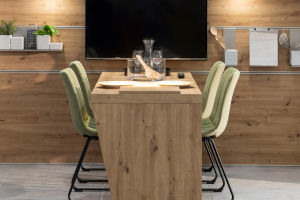
- Tactile Contrast: Since color is restricted, interest is generated through texture. Pair a smooth, cold concrete floor with a warm, brushed oak table or a matte-finish linen sofa.
- Hidden Hardware: Utilize "touch-to-open" cabinetry and recessed lighting tracks. Eliminating visible handles and bulb housings removes "mechanical noise" from the visual field.
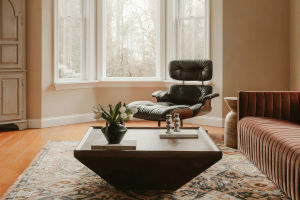
- The Hero Object: Select one high-spec specimen—perhaps a sculptural chair or a singular piece of oversized art—to serve as the "gravity well" for the room's focus.
Operational Decluttering
The greatest challenge to a minimalist interior is the "daily entropy" of human life. To maintain the aesthetic, the home must be engineered with a high-capacity "concealment system."
Every functional item, from charging cables to kitchen appliances, must have a designated "docking station" behind integrated cabinetry. This is the "SOP" of hidden storage: if it isn't in use, it shouldn't exist in the visual field. Lighting should be treated as a "programmable layer," with dimmable circuits that can shift the room's mood from a bright, clinical workspace to a warm, shadowed evening sanctuary. By controlling the "lumens," you control the perceived volume of the space.
The Reflection of the Void
At the end of the day, a minimalist interior is a mirror. When you remove the "atmospheric noise" of excessive possessions, you are left with nothing but your own thoughts and the quality of the light hitting the walls.
Reflect on your own "internal inventory": Are you filling your life with "filler objects" to distract from the silence, or do you have the courage to stand in an empty room? Minimalism teaches us that the most valuable thing we can own is "unoccupied space." It reminds us that we are not defined by the weight of our hoard, but by the clarity of our focus. Are you ready to apply the "circuit breaker" to your consumer habits and find the beauty in the bare essentials, or are you still afraid of the void?
Success is found in what you choose to leave out.