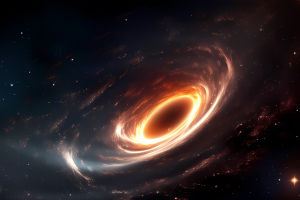
Imagine this: a region of space so dense that nothing—no matter, no light—can escape from it.
This place is known as a black hole, and while it might sound like something from a science fiction novel, black holes are real, and they are one of the universe's most mysterious and powerful forces.
What's even more mind-boggling is how they devour everything that comes near, including entire stars. Let's explore the physics of how black holes “eat” matter, a process that's as incredible as it is terrifying.
What is a Black Hole?
Before we get into how black holes consume matter, let's briefly explain what they are. A black hole is a region in space where gravity is so strong that it pulls everything inward. This happens because a massive amount of mass is concentrated in an incredibly small area, creating a gravitational field so intense that even light cannot escape. The point of no return, where anything that enters is trapped forever, is called the event horizon.
• Event Horizon: The boundary around a black hole where escape becomes impossible, even for light.
• Singularity: The point at the center of a black hole where all its mass is concentrated in a single point, infinitely dense.
Understanding these concepts helps us appreciate just how powerful and dangerous black holes can be. But the real intrigue lies in how black holes pull matter toward them.
The Accretion Disk: A Matter Funnel
When a black hole starts pulling in matter, it doesn't just grab it all at once. Instead, the material forms a rotating disk around the black hole, known as the accretion disk. This disk is composed of gas, dust, and other cosmic debris that gets pulled in by the black hole's immense gravity. The material in the disk moves at incredibly high speeds, and the friction between the particles causes them to heat up and emit radiation, often in the form of X-rays.
• High-Speed Rotation: As matter spirals into the black hole, it speeds up, creating extreme friction and heating up the material.
• Radiation: The friction generates heat, which causes the accretion disk to shine brightly in X-rays or other wavelengths, making it one of the most visible features of a black hole.
One fascinating fact about this process is how the accretion disk helps astronomers observe black holes. Even though light can't escape a black hole itself, the radiation from the accretion disk can give scientists valuable insights into a black hole's size, behavior, and even the physics of space-time around it.
Spaghettification: The Stretching Effect
As matter gets closer to a black hole, it begins to experience a gravitational force so strong that it stretches and compresses, a process known as spaghettification. Imagine an astronaut falling feet-first into a black hole—his feet would experience a stronger gravitational pull than his head, pulling him apart into a long, thin shape, much like spaghetti. This effect happens because the gravitational pull increases as you get closer to the singularity.
• Tidal Forces: The difference in gravity between different parts of an object causes it to stretch.
• Breaking Point: Once the forces become too extreme, the object can no longer hold itself together and is torn apart.
While this is a dramatic way to describe the process, spaghettification happens to all objects, whether they're small pieces of dust or entire stars, as they venture too close to the black hole.
The Role of Hawking Radiation
The process of a black hole devouring matter is well-understood, but what about the possibility of a black hole losing mass? This brings us to a fascinating concept introduced by physicist Stephen Hawking in 1974: Hawking radiation.
According to quantum mechanics, black holes can actually emit radiation due to particle-antiparticle pairs that form near the event horizon. One particle can fall into the black hole, while the other escapes into space. Over time, this radiation could cause the black hole to lose mass and eventually evaporate—a process that takes far longer than the age of the universe but is still theoretically possible.
• Particle-Antiparticle Pairs: These pairs spontaneously form near the event horizon, and one of them may escape, carrying energy away from the black hole.
• Black Hole Evaporation: This radiation could slowly drain a black hole's mass, making it shrink and eventually disappear.
Hawking radiation is still theoretical, but it opens up intriguing possibilities about the long-term fate of black holes. It suggests that black holes, despite being known for their insatiable hunger, could also lose matter over time, although this is a very slow process.
The Role of Black Holes in Galaxy Formation
Black holes aren't just destructive—they play a key role in the formation and evolution of galaxies. Many large galaxies, including our own Milky Way, are thought to have supermassive black holes at their centers. These black holes are essential for regulating the growth of galaxies. The energy and radiation emitted by the accretion disks of these supermassive black holes can influence the formation of stars and the overall structure of the galaxy.
• Feedback Mechanism: The energy from the black hole can heat up surrounding gas, preventing it from collapsing into new stars. This keeps galaxies in a state of balance.
• Galaxy Evolution: The presence of a supermassive black hole at the center of a galaxy may influence its shape, size, and star formation rate over billions of years.
Thus, black holes are more than just cosmic vacuums—they help shape the very galaxies they inhabit, making them vital players in the universe's ongoing evolution.
Black Holes and the Unknown
The way black holes devour matter is a reminder of the incredible power and mystery that still exists in the universe. From the formation of the accretion disk to the mind-boggling effects of spaghettification, black holes challenge our understanding of physics, space, and time.
While we've made incredible strides in observing and understanding these cosmic monsters, much about them remains a mystery. But one thing is certain: black holes are far more than just massive voids—they are active, dynamic objects that shape the universe in ways we are only beginning to understand.