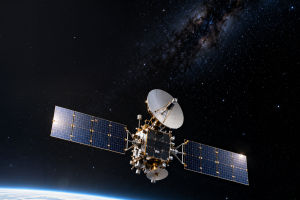
A space telescope does not always work best close to Earth. While observatories such as Hubble have transformed astronomy from low Earth orbit, others need more consistent temperatures and fewer interruptions. For these missions, engineers often choose a location near a Lagrange point, where gravity and orbital motion create useful conditions for long-term observations.
The Sun–Earth L2 point is especially valuable for studying distant galaxies and faint infrared light. Located about 1.5 million kilometers beyond Earth, it allows telescopes such as the James Webb Space Telescope to maintain carefully controlled temperatures. But this distant location comes with important engineering challenges and trade-offs.
What Makes Lagrange Points Special?
Lagrange points are five locations in a system of two large orbiting bodies where the combined gravitational influence of the two bodies allows a much smaller object to remain approximately in the same position relative to them.
In the Sun–Earth system, these locations are labeled L1 through L5.
L1 lies between Earth and the Sun, while L2 is positioned beyond Earth on the side opposite the Sun. L3 is on the far side of the Sun, and L4 and L5 lie approximately 60 degrees ahead of and behind Earth along its orbit.
These locations are named after mathematician Joseph-Louis Lagrange, who studied the three-body problem. Leonhard Euler had previously identified the three points now called L1, L2, and L3.
At these locations, the combined gravitational forces provide the acceleration needed for a small object to maintain its position in a frame rotating with the two larger bodies.
However, not all five points are equally stable. L1, L2, and L3 are dynamically unstable, while L4 and L5 can be stable under suitable conditions.
For spacecraft, the value of a Lagrange point lies in its useful orbital geometry rather than an absence of gravity.
Why L2 Is Ideal for Infrared Telescopes
The Sun–Earth L2 point lies approximately 1.5 million kilometers from Earth, in the direction away from the Sun.
From this region, the Sun, Earth, and Moon remain in roughly the same part of the sky. This arrangement is especially useful for telescopes that must minimize unwanted light and heat.
NASA's James Webb Space Telescope operates in a large halo orbit around L2 rather than sitting directly at the point.
Webb uses a five-layer sunshield to separate its warm, Sun-facing equipment from the cold mirrors and instruments on its observing side.
This shielding helps the telescope's main optical system remain below approximately 50 kelvin, or −223°C. Its Mid-Infrared Instrument requires additional cooling to around 7 kelvin.
Such low temperatures are essential because warm telescope components emit infrared radiation that could overwhelm the faint signals astronomers want to detect.
L2 provides the geometry needed for Webb's sunshield to protect its sensitive equipment while allowing extended observations of distant astronomical targets.
How L2 Reduces Observing Interruptions
A telescope in low Earth orbit repeatedly passes around the planet, encountering changing lighting conditions and periods when Earth blocks its view.
Hubble completes an orbit approximately every 95 minutes. Although it has produced extraordinary scientific results, Earth occasionally obstructs its targets, and its instruments must operate through repeated environmental changes.
Observatories near L2 avoid many of these interruptions because Earth occupies a relatively small region of their sky.
Webb can observe a large portion of the celestial sphere while keeping its sunshield correctly oriented toward the Sun, Earth, and Moon.
It cannot point in every direction at once. Its sunshield imposes pointing restrictions, so different regions of the sky become accessible at different times of year.
Nevertheless, this arrangement provides long observing windows and a comparatively stable thermal environment.
These advantages are particularly important for sensitive infrared measurements, where small temperature changes can interfere with observations.
Why Spacecraft Still Need Fuel at L2
Lagrange points are sometimes described as gravitational parking places, but a spacecraft cannot simply remain near L2 indefinitely without corrections.
L1, L2, and L3 are unstable equilibrium points. Small disturbances and navigation errors can gradually move a spacecraft away from its intended trajectory.
Instead of remaining motionless at L2, observatories typically travel along halo or Lissajous orbits around the point.
These trajectories allow spacecraft to maintain useful observing geometry while avoiding undesirable alignments and eclipses.
Small engine burns, known as station-keeping maneuvers, keep the spacecraft within its planned orbit.
The required corrections are relatively modest compared with the propulsion needed to reach the region in the first place.
Webb's operational lifetime is partly constrained by the propellant available for station-keeping and momentum management.
Its precise launch and early trajectory corrections conserved more fuel than originally anticipated, supporting an expected operational lifetime exceeding the mission's initial ten-year planning goal.
Why Not Keep Every Telescope Near Earth?
Low Earth orbit offers advantages that make it suitable for many scientific missions.
Spacecraft there are comparatively close to ground stations, and some can be reached by crewed missions. Hubble benefited enormously from this accessibility.
Astronauts serviced Hubble five times between 1993 and 2009, installing new instruments and repairing or replacing equipment. Its first servicing mission also corrected the effects of a flaw in its primary mirror.
Such repairs are far more difficult for observatories operating near L2.
However, low Earth orbit is not always the best environment for instruments requiring continuous thermal protection or extended observations without Earth blocking the view.
Different Lagrange points also support different scientific objectives.
Spacecraft near the Sun–Earth L1 point, including the Solar and Heliospheric Observatory, can monitor the Sun without Earth regularly interrupting their observations.
L2 is particularly useful for observatories studying the distant universe, although the final orbital choice depends on each mission's scientific and engineering requirements.
The Advantages and Risks of a Distant Orbit
Operating near L2 offers favorable observing conditions, but the distance introduces complications.
At approximately 1.5 million kilometers from Earth, Webb is far beyond the reach of the servicing missions that maintained Hubble.
Its instruments, mechanisms, and sunshield were therefore designed with extensive testing, redundancy, and carefully planned deployment procedures.
Communication also takes longer. A radio signal traveling between Earth and the L2 region requires roughly five seconds each way, although actual operational delays depend on the communication system.
Other observatories have benefited from this location.
NASA's Wilkinson Microwave Anisotropy Probe studied the cosmic microwave background from an orbit near L2, while the European Space Agency's Planck mission used the region for precision measurements of the early universe.
ESA's Gaia spacecraft also operated near L2 while mapping the positions and motions of stars.
These missions demonstrate that L2 is useful for more than infrared astronomy. Its geometry and relatively stable observing environment support several types of precision space science.
Lagrange points offer spacecraft useful orbital arrangements, and L2 has become an important destination for observatories requiring precise, uninterrupted measurements. Its geometry allows telescopes such as Webb to maintain effective thermal shielding while observing distant objects without frequent obstruction by Earth. The location is not perfectly stable, however, and spacecraft still need occasional course corrections. Distance also makes repairs challenging.